And how silence became my story
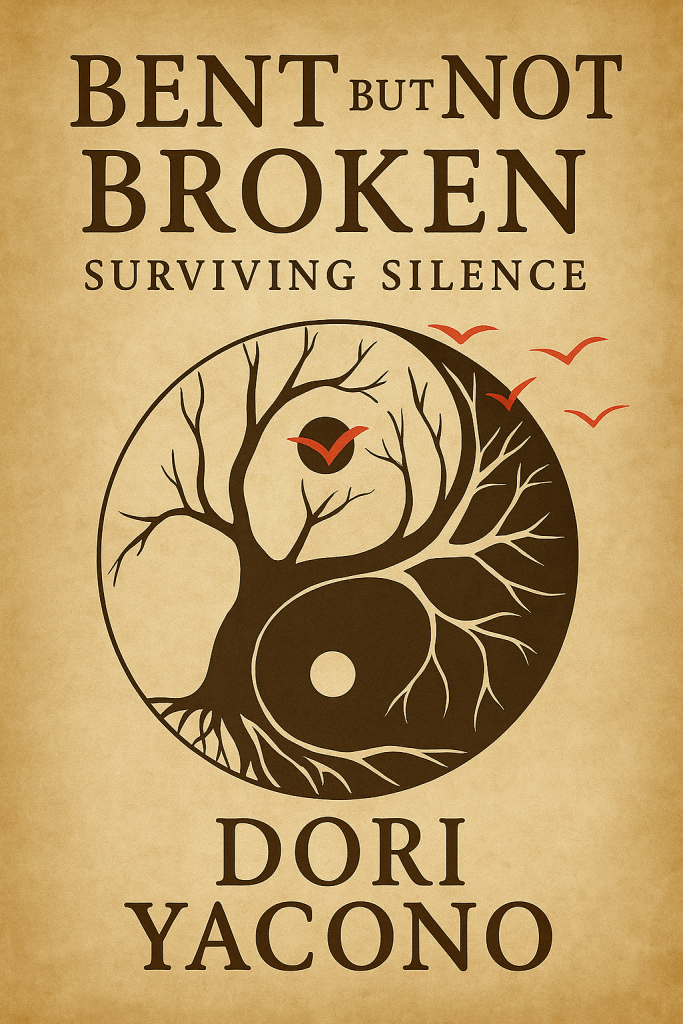
When people ask why I chose to write a memoir, I usually hesitate. The real answer isn’t tidy. It’s not a marketing tagline or a well-rehearsed elevator pitch. It’s layered, personal, and, if I’m being honest, still unfolding. So I thought I’d start here—with the first few lines from Chapter 1 of Bent but Not Broken: Surviving Silence, because they say more than I could in any introduction:
Today, silence means peace. A quiet room. A still morning. Coffee brewing. A deep breath, or a gentle spring rain.
However, when I was young, silence meant something else entirely. It wasn’t calm, it was survival. Silence meant no yelling. No slamming doors. No footsteps—no trouble coming down the hall.
When things were quiet, it meant we were safe—or at least safer. I learned early that the only way to stay invisible was to say nothing at all. In my world, silence wasn’t the absence of noise—it was the presence of control. But disappearing came at a cost. The quieter I became, the harder it was to remember I had a voice.
I didn’t begin as a writer. I began as a reader. Books were my lifeline—first as an escape, later as a kind of armor. They took me away to places where the monsters could be fought and sometimes even defeated. I read constantly. At school, a book in my hands became a shield—something I could hide behind. Books didn’t stare. They didn’t ask questions. They didn’t notice the sadness, or the weight of shame, or the invisible heaviness I carried. I trusted them. They never disappointed me, and I never had to worry about disappointing them.
For a long time, I never imagined I could write one. I never thought my words would matter to anyone else, let alone carry the weight of truth. But somewhere, quietly, a seed was planted: maybe I could be the kind of writer I once needed. Maybe I could offer someone else the comfort I used to find tucked between the pages of a library book.
I tried to write my story many times over the years. I thought if I could finally tell it—truly tell it—it might loosen its grip on me. Maybe I’d be able to breathe a little easier. I tried to write it exactly as it happened. I tried giving people new names. I tried turning it into fiction. Nothing worked. Every version felt hollow. No matter how I approached it, the story stayed tangled in my chest.
As a teacher, I’ve worked on guiding students through their own narratives. I’ve taught them how to write about their memories, their families, their fears. And like any good teacher, I wrote alongside them—safe essays about my gram, or buying a kayak, or the quiet beauty of Mount Ascutney. I wrote stories that felt safe to share, and I got used to dipping just a toe into deeper waters without ever really jumping in.
Then, earlier this year, I started an extra-curricular creative writing group where students were encouraged to write novels. I told them I would write with them. I meant it. Twice a week, I sat down and typed while they worked quietly around me. At first, I tried fiction again. One story idea involved undoing past mistakes; another began as a mystery with a woman waking up in a hospital with no memory of who she was. But neither story made it very far. They didn’t hold me the way my truth did.
In class, I kept writing personal essays—short, vivid ones. Something began to shift. When I wrote about a childhood memory, I could see myself inside it. When I wrote about a quiet morning on a mountaintop, I could feel it again, close my eyes and feel the sun on my face. Writing stopped being an exercise and started becoming something else entirely: a way back to myself.
On April 29, 2025, I sat down and began writing something I’d tried so many times before and failed. I started with my marriage. Maybe it was the emotion of my daughter preparing to get married herself. Maybe it was the ache of missing my late husband. Maybe I was finally ready. Whatever the reason, this time the words came. And they didn’t stop. I wrote every day for three weeks. And in those three weeks, I wrote over 75,000 words. It wasn’t just a journal or an essay or another attempt—it was a book. A memoir. Bent but Not Broken.
I write memoir because it’s the only way I know how to reclaim the parts of me that went silent for too long. I write to make sense of the chaos. I write to bear witness. I write for the girl who was told to disappear, and for the woman who spent years trying to remember she existed. I write because silence shouldn’t win. Because someone, somewhere, might be carrying a story like mine—and they need to know they’re not alone.
And if my words help even one person feel seen… then every sentence was worth it.

Leave a comment